
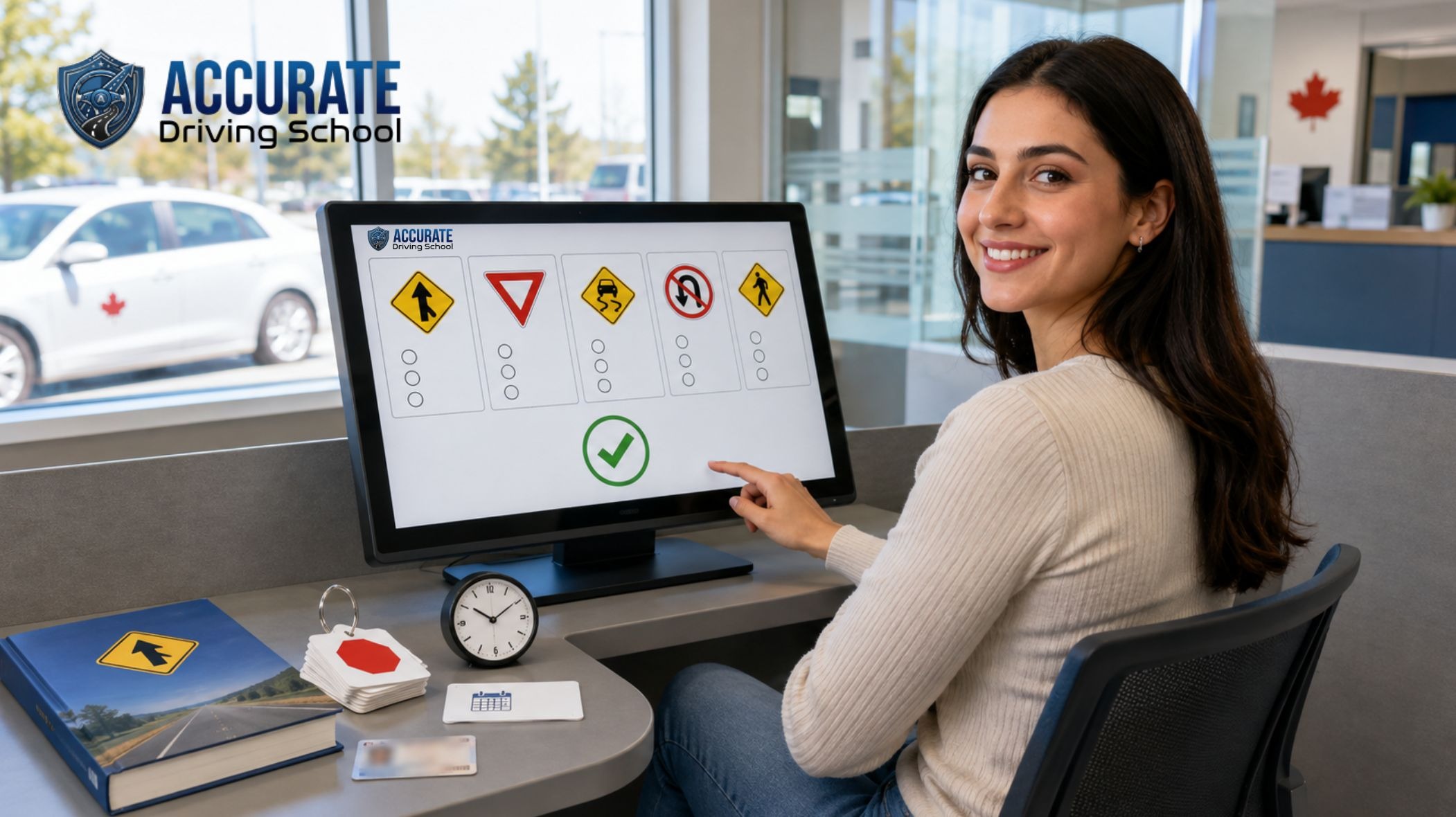
Passing the G2 written test is an important milestone for new drivers in Ontario. Before progressing through Ontario’s graduated licensing system, new drivers need to demonstrate their knowledge of traffic signs, rules of the road, and safe driving practices.
For many first-time drivers, the challenge is not simply finding information to study. It is knowing what to study, how to remember it, and how to recognize the correct answer when a question is worded differently from what you have practised.
The good news is that effective preparation does not have to be complicated. By using the official Ontario Driver’s Handbook, studying traffic signs, practising knowledge-test questions, understanding the rules instead of memorizing answers, and preparing properly for test day, you can make your study sessions more productive.
This guide explains five essential tips for G2 written test success and provides practical strategies that can help you prepare with greater confidence.
Understanding the G2 Written Test in Ontario
Before discussing preparation strategies, it is important to understand how Ontario’s knowledge-testing system works.
New drivers in Ontario begin the graduated licensing process by applying for a G1 licence. This involves a vision test and a knowledge test covering the rules of the road and traffic signs. Once you obtain your G1 licence, you can begin gaining driving experience and eventually take the road test to progress to the G2 level.
DriveTest explains that knowledge tests are multiple-choice examinations created by the Ministry of Transportation (MTO). They are based on the official driver’s handbook and are available at DriveTest Centres. Knowledge tests are not timed, and you receive your result immediately after completing the test.
For a Class G1 knowledge test, the questions generally cover areas such as:
- Traffic signs
- Rules of the road
- Speed limits
- Emergency vehicles
- Passing
- Highway driving
- School buses
- Streetcars
- Driver responsibilities
- Sharing the road
- Collision reporting
- Demerit points
- Safe driving practices
The official MTO handbook also provides sample knowledge-test questions so learners can become familiar with the multiple-choice format.
Tip 1: Study the Official Ontario Driver’s Handbook
The most important preparation strategy for your G2 written test is to study the official Ontario Driver’s Handbook.
The handbook is the primary resource you should use to understand the information covered by the knowledge test. The Ontario government describes the handbook as a resource for studying for the G1 driver licence test and preparing for the Level Two road test.
Instead of depending entirely on random online quizzes, social-media posts, or videos, use the official handbook as your foundation.
What Should You Study?
Don’t read the handbook casually from beginning to end and assume you will remember everything.
Break the material into subjects.
Traffic Signs
Study the meaning of:
- Stop signs
- Yield signs
- Warning signs
- Speed-limit signs
- Parking signs
- Railway-crossing signs
- Pedestrian signs
- Construction signs
- Lane-use signs
- School-zone signs
Try to understand what each sign requires you to do rather than simply memorizing its appearance.
Rules of the Road
Pay close attention to:
- Right-of-way
- Intersections
- Turning
- Passing
- Lane changes
- Parking
- Following distances
- Traffic signals
- Emergency vehicles
Safe Driving
Also review:
- Distracted driving
- Impaired driving
- Seat belts
- Defensive driving
- Sharing the road
- Highway driving
- Driving at night
- Driving in poor weather
DriveTest confirms that knowledge-test questions are based on the official driver’s handbook for the licence class being tested.
Make Short Notes
Instead of copying entire sections, write short notes in your own words.
For example:
Topic: Lane Changes
Remember: Mirrors → Signal → Blind spot → Safe movement
This makes revision faster.
Tip 2: Master Ontario Traffic Signs
Traffic signs are an important part of preparing for the G2 written test.
Many learners try to memorize signs individually, which can become confusing when several signs look similar.
A better method is to understand signs according to their purpose.
Regulatory Signs
Regulatory signs communicate rules and restrictions.
Examples include signs relating to:
- Stopping
- Yielding
- Speed limits
- Parking
- Turns
- Passing
- Lane restrictions
When studying these signs, ask yourself:
What action does this sign require from the driver?
Warning Signs
Warning signs alert drivers to potential hazards or changes ahead.
These may indicate:
- Curves
- Intersections
- Pedestrian crossings
- Railway crossings
- Slippery conditions
- Construction
- Road changes
Don’t only memorize the picture. Think about how you should respond when you see the sign on an actual road.
Information Signs
Information signs can provide information about:
- Routes
- Destinations
- Services
- Facilities
- Road conditions
Understanding the purpose of different categories can make sign recognition much easier.
Tip 3: Practise G2 Knowledge-Test Questions
Once you have studied the handbook, start practising questions.
Practice tests are useful because they help you identify what you know and where you need additional study.
The official MTO handbook includes sample questions in multiple-choice format. DriveTest also confirms that knowledge tests use multiple-choice questions.
However, there is an important difference between practising questions and memorizing answers.
Don’t Memorize the Answer Pattern
Suppose you answer a question correctly because you remember that the answer was option C.
That doesn’t necessarily mean you understand the rule.
Instead, ask:
Why is C correct?
If you understand the reason, you will be better prepared if the actual question uses different wording.
Keep a Mistake List
Every time you answer incorrectly, record the topic.
For example:
| Topic | Mistakes |
|---|---|
| Traffic signs | 2 |
| Right-of-way | 4 |
| Parking | 1 |
| Emergency vehicles | 3 |
| Highway rules | 2 |
Then spend more time studying the subjects where you make the most mistakes.
This is much more efficient than repeatedly studying information you already know.
Tip 4: Understand the Rules Instead of Memorizing Answers
One of the strongest strategies for G2 written test success is learning the reasoning behind Ontario’s driving rules.
The purpose of the knowledge test is to determine whether you understand the rules of the road and traffic signs.
For this reason, understanding concepts is more useful than memorizing individual questions.
Example: Following Distance
Don’t simply memorize an answer about following distance.
Understand why maintaining adequate space is important.
A safe following distance gives you more time to respond if the vehicle ahead:
- Brakes suddenly
- Changes lanes
- Encounters an obstacle
- Slows because of traffic
- Encounters a hazard
Example: Lane Changes
Instead of memorizing one multiple-choice answer, understand the basic process.
Before changing lanes, you should:
- Check your surroundings.
- Check your mirrors.
- Signal.
- Check your blind spot.
- Make sure the movement is safe.
- Change lanes smoothly.
Example: Intersections
When studying intersections, don’t just memorize who goes first in one example.
Understand how right-of-way rules apply to different situations.
This makes it easier to solve questions you haven’t seen before.
Tip 5: Prepare Properly for Test Day
Even if you have studied thoroughly, poor preparation on test day can create unnecessary stress.
A successful G2 written test experience starts before you enter the testing centre.
Get Enough Sleep
Avoid staying awake all night trying to memorize information.
Being rested can help you concentrate and read questions carefully.
Review Your Weak Areas
The day before your test, focus on the subjects where you have made mistakes.
For example:
- Traffic signs
- Right-of-way
- Parking
- Emergency vehicles
- Highway rules
Avoid trying to memorize the entire handbook in one night.
Prepare Your Identification
Ontario’s G1 knowledge-test checklist says applicants should bring two pieces of identification, money for the test fees, and glasses or contact lenses if needed for driving.
Make sure your documents are ready before leaving home.
Arrive Early
DriveTest says knowledge tests do not require an appointment at DriveTest Centres, but recommends arriving at least one hour before the office closes so there is enough time to register and complete the test.
Arriving early also gives you time to settle down before testing.
Important G2 Written Test Topics to Review
Your study plan should cover the major subjects found in the official handbook.
Right-of-Way
Understand who has priority in different traffic situations.
Pay particular attention to:
- Intersections
- Four-way stops
- Yield situations
- Turning vehicles
- Pedestrians
- Emergency vehicles
Traffic Lights
Know what different traffic-light signals require you to do.
Review:
- Green lights
- Yellow lights
- Red lights
- Green arrows
- Flashing signals
School Buses
Study the rules governing approaching and passing school buses.
This is an important safety topic and should be understood rather than memorized.
Emergency Vehicles
Know how drivers should respond when emergency vehicles approach with their warning devices activated.
Passing
Understand when passing is permitted and when it is unsafe or prohibited.
Highway Driving
Review:
- Entering highways
- Exiting highways
- Lane changes
- Passing
- Speed management
- Safe following distance
Parking
Study parking restrictions and safe parking practices.
Sharing the Road
Learn how drivers should interact safely with:
- Pedestrians
- Cyclists
- Motorcycles
- Large commercial vehicles
- School buses
- Streetcars
The official MTO handbook specifically identifies traffic signs, emergency vehicles, headlights, speed limits, freeway driving, school buses, passing, collision reporting, sharing the road, and rules of the road among the areas that may be covered by the written test.
Create a Simple G2 Written Test Study Schedule
A study schedule can make preparation much easier.
Instead of studying everything in one day, divide the material into manageable sessions.
Day 1: Traffic Signs
Study different sign categories and test yourself.
Day 2: Rules of the Road
Review intersections, right-of-way, turns, and lane changes.
Day 3: Safe Driving
Study defensive driving, following distances, distractions, and responsible driving.
Day 4: Highway and Passing Rules
Review highway entry and exit, passing, lane changes, and safe driving practices.
Day 5: Parking and Special Situations
Review parking restrictions, emergency vehicles, school buses, and other special situations.
Day 6: Practice Test
Take a full practice test without using your notes.
Day 7: Weak Areas
Review every question you got wrong.
This approach can be more effective than trying to study the entire handbook at once.
How to Improve Your Memory While Studying
Memorizing driving rules becomes easier when you use active learning.
Use Flashcards
Create flashcards for traffic signs and important rules.
Front: Sign
Back: Meaning + required driver action
Test Yourself
Close the handbook and explain a rule from memory.
If you cannot explain it, review the section again.
Teach Someone Else
Try explaining a traffic rule to a friend or family member.
If you can explain it clearly, you probably understand it.
Repeat Difficult Information
Review difficult topics several times instead of studying them only once.
What If English Is Not Your First Language?
Ontario provides several options for knowledge testing.
DriveTest states that computerized Class G1 knowledge tests are available in 32 languages, including English, French, Arabic, Bengali, Hindi, Punjabi, Urdu, Spanish, and several others.
Computerized knowledge tests also have audio functionality, allowing applicants to listen to questions and repeat or skip them as needed.
If you require a verbal test or an interpreter because of an accommodation need, DriveTest provides specific procedures for arranging this.
If you are more comfortable studying in another language, check the available testing options before your test.
What to Expect at the Knowledge Test
Knowing what to expect can reduce anxiety.
DriveTest states that knowledge tests are:
- Multiple choice
- Created by the MTO
- Based on the official driver’s handbook
- Not timed
- Marked immediately
- Available at DriveTest Centres
DriveTest says each knowledge test typically takes around 20 to 30 minutes and requires a total score of at least 80% to pass. If you are unsuccessful, you can pay the applicable fee and try again.
Your test result is available immediately, so you won’t normally need to wait several days to find out whether you passed.
What If You Don’t Pass the G2 Written Test?
Don’t panic if you don’t pass on your first attempt.
A failed attempt can actually show you which topics require additional study.
DriveTest states that unsuccessful applicants can pay the applicable fee and try again. It also notes that test results remain valid for one year and, when applicable, a retest within that period requires only the sections that did not meet MTO standards.
After an unsuccessful attempt:
- Identify the sections you struggled with.
- Return to the official handbook.
- Review those subjects carefully.
- Practise additional questions.
- Take another practice test.
- Try again when you feel prepared.
Avoid immediately repeating the test without changing your study strategy.
Common G2 Written Test Preparation Mistakes
Knowing what not to do can be just as useful as knowing what to do.
Studying Only Practice Tests
Practice questions are helpful, but they should not replace the official handbook.
Memorizing Answers
Questions may be presented differently, so understanding the rule is more reliable.
Ignoring Traffic Signs
Traffic signs represent a major part of the knowledge-testing material.
Cramming at the Last Minute
Long study sessions immediately before the test can be less effective than regular study over several days.
Skipping Difficult Topics
If you repeatedly get questions wrong about right-of-way, parking, or highway rules, don’t ignore them.
Not Reading Questions Carefully
Even if you know the subject, rushing through a question can cause you to miss an important detail.
How to Stay Calm During the G2 Written Test
Test anxiety is common, especially for first-time drivers.
A few simple habits can help.
Read Slowly
You don’t need to rush because the knowledge test is not timed.
Think About the Rule
If you don’t immediately know the answer, think about the driving principle being tested.
Eliminate Clearly Wrong Options
If you’re uncertain, remove answers that clearly conflict with safe driving or Ontario road rules.
Don’t Change Answers Without a Reason
If you initially select an answer and then change it, have a clear reason for doing so.
Stay Focused
Don’t worry about how quickly other people are completing their tests.
Your goal is to answer accurately.
Should You Take a Beginner Driver Education Course?
A Beginner Driver Education course is not required simply to take the G1 knowledge test, but it can be useful for new drivers.
DriveTest describes MTO-approved BDE courses as an option that can teach the skills and attitudes needed to become a safe and responsible driver.
Ontario also encourages new drivers to take an approved driver-education course to help them develop proper driving skills and knowledge.
If you decide to take a BDE course, make sure the school and program are approved by the Ministry of Transportation.
G2 Written Test Checklist
Use this checklist before your test.
Study
- Read the official Ontario Driver’s Handbook
- Review traffic signs
- Study rules of the road
- Review right-of-way
- Study parking rules
- Review highway rules
- Study emergency-vehicle rules
- Review school-bus rules
- Practise knowledge-test questions
Before the Test
- Review your weak areas
- Get enough sleep
- Prepare your identification
- Confirm the location
- Plan your transportation
- Bring glasses or contact lenses if required
During the Test
- Read every question carefully
- Don’t rush
- Think about the rule
- Eliminate clearly incorrect answers
- Stay calm
- Review your selection before moving forward when appropriate
Frequently Asked Questions About the G2 Written Test
Is the G2 written test timed?
Knowledge tests at DriveTest are not timed. DriveTest states that you can take the time you need to complete the test until the office closes.
What score do I need to pass?
DriveTest states that you need a total score of at least 80% to pass the knowledge test.
Where do G1 knowledge-test questions come from?
Knowledge-test questions are based on the official driver’s handbook for the applicable licence class.
Do I need an appointment for the knowledge test?
DriveTest states that appointments are not required for computerized knowledge tests at its centres. However, applicants should arrive early enough to complete registration and testing before the office closes.
Can I take the test in Urdu?
Yes. DriveTest lists Urdu among the languages available for computerized and paper Class G1 knowledge tests.
What should I bring to the G1 knowledge test?
Ontario’s handbook checklist says to bring two pieces of identification, money for test fees, and glasses or contact lenses if you need them for driving.
What happens if I fail?
You can pay the applicable fee and try again. DriveTest also states that results are valid for one year and that, for a retest within that period, only sections that did not meet MTO standards need to be retaken.
Is an MTO-approved driving course required before the knowledge test?
No. An approved BDE course is optional, although Ontario encourages new drivers to consider driver education.
Final Thoughts: 5 Essential Tips for G2 Written Test Success
Preparing for the G2 written test doesn’t have to be stressful when you use a structured approach.
The five most important strategies are:
- Study the official Ontario Driver’s Handbook.
- Learn traffic signs and understand what they require.
- Practise knowledge-test questions and track your mistakes.
- Understand driving rules instead of memorizing answers.
- Prepare properly for test day and take your time.
Remember that the knowledge test is designed to evaluate your understanding of road rules and traffic signs.
Your preparation should therefore focus on genuine understanding rather than simply trying to memorize a collection of questions.
Once you pass your knowledge test and receive your G1 licence, the next stage is gaining practical driving experience. The knowledge you develop while studying will become the foundation for your future driving lessons and road-test preparation.
Use the official handbook, practise consistently, focus on your weak areas, and approach the test calmly.
Study the rules. Understand the signs. Practise consistently. Drive safely.