
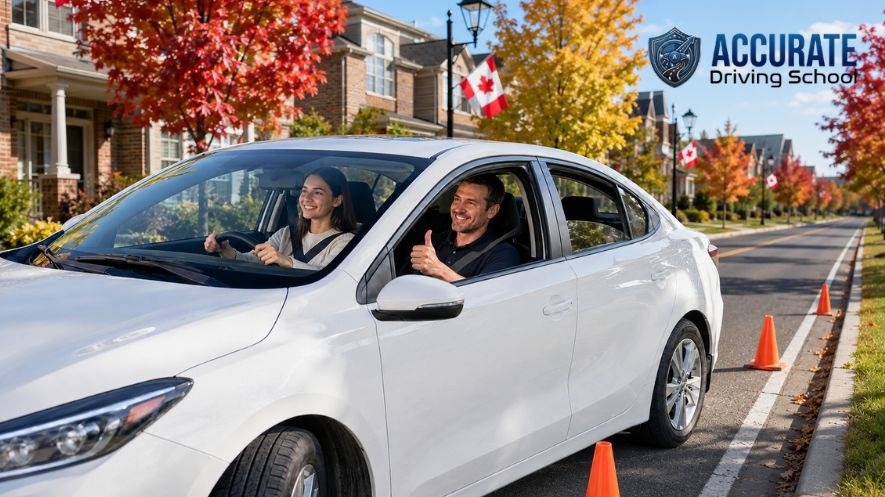
Learning to drive is an important step toward independence, but becoming a safe and confident driver requires more than simply passing a road test. Professional instruction can help new drivers understand Ontario road rules, develop proper driving habits, and gain practical experience in different traffic situations.
Choosing the right Whitby Driving School can give learners the structured training they need to build confidence behind the wheel. From basic vehicle control and parking to highway driving and road-test preparation, professional lessons can be adapted to different experience levels and learning needs.
Whitby has several driving schools offering services such as Beginner Driver Education (BDE), private lessons, road-test preparation, and in-car training. Local options include Whitby Driving School | Driving Lessons | Drivers Learning Center | G2 Classes | Driving Test Center, SAMS Driving School, Drive Guru, and other providers serving the Durham Region.
Why Choose a Professional Whitby Driving School?
Professional driving lessons provide students with more than basic vehicle practice.
A qualified instructor can identify mistakes, explain why they happen, and demonstrate safer techniques. This can be particularly helpful for first-time drivers who are still learning how to manage the vehicle while observing traffic around them.
A professional Whitby Driving School can help students develop skills including:
- Vehicle control
- Steering and braking
- Traffic-sign recognition
- Lane positioning
- Intersections
- Lane changes
- Parking
- Highway driving
- Defensive driving
- Road-test preparation
The objective should be to help students become safe and independent drivers rather than simply teaching them how to complete a test.
Build Strong Driving Fundamentals
Every confident driver starts with the basics.
New drivers need to become comfortable with controlling their vehicle before moving on to more complicated traffic situations.
Basic training can include:
- Adjusting mirrors and seating position
- Understanding vehicle controls
- Smooth acceleration
- Controlled braking
- Steering
- Signalling
- Mirror checks
- Blind-spot awareness
- Proper stopping procedures
- Maintaining safe following distances
These skills may seem simple, but they form the foundation for almost every other driving technique.
A good instructor will gradually increase the difficulty of lessons as the student’s confidence and ability improve.
Learn Ontario Road Rules
Understanding road rules is an essential part of becoming a responsible driver.
Students should learn how traffic signs, signals, lane markings, intersections, and right-of-way rules affect their decisions on the road.
A professional instructor can connect the theory to real driving situations.
For example, instead of simply memorizing the meaning of a stop sign, students can learn how to approach an intersection safely, where to stop, how to observe surrounding traffic, and when it is safe to proceed.
This combination of knowledge and practical training can make lessons more useful.
Improve Your Parking Skills
Parking is one of the areas where many new drivers need additional practice.
A professional instructor can break parking manoeuvres into simple steps and help students understand vehicle positioning.
Training may cover:
Parallel Parking
Students learn how to position the vehicle, use mirrors, check surrounding traffic, and make controlled steering adjustments.
Reverse Parking
This requires awareness of the vehicle’s position and surroundings while moving slowly and carefully.
Three-Point Turns
Students can learn how to perform the manoeuvre while maintaining proper observation and vehicle control.
Parking Lot Skills
Lessons can also include entering and exiting parking spaces, navigating tight areas, and watching for pedestrians and other vehicles.
Whitby Driving School specifically lists parallel parking among its driving-training services.
Gain Confidence With Highway Driving
Highway driving can be intimidating for new drivers.
Higher speeds and heavier traffic require good observation, decision-making, and vehicle control.
Professional instruction can introduce highway driving gradually.
Students can practice:
- Entering highways
- Accelerating safely
- Maintaining appropriate speed
- Checking mirrors
- Checking blind spots
- Changing lanes
- Maintaining following distance
- Exiting highways
- Responding to changing traffic conditions
Whitby Driving School lists both freeway driving and highway and city driving among its training areas.
The instructor can provide guidance while the student develops confidence and learns to make decisions independently.
Learn Defensive Driving Skills
Passing a road test is important, but safe driving continues long after the test.
Defensive driving teaches students to anticipate potential hazards instead of reacting only when something goes wrong.
A defensive driver constantly observes the road environment and considers what other road users may do next.
Important defensive-driving habits include:
- Maintaining a safe following distance
- Checking mirrors regularly
- Watching for pedestrians and cyclists
- Anticipating sudden braking
- Checking blind spots
- Adjusting speed for conditions
- Avoiding distractions
- Remaining aware of surrounding vehicles
These habits can help drivers respond more effectively to unexpected situations.
Whitby Driving School states that its road training includes teaching students how to identify and prevent dangerous collisions.
Prepare for Your G2 Road Test
For many learners, the next major goal after gaining basic experience is the G2 road test.
Professional lessons can help students identify areas that need improvement before the test.
G2 preparation may include:
- Turns
- Stops
- Lane changes
- Intersections
- Parallel parking
- Three-point turns
- Speed control
- Mirror checks
- Blind-spot checks
- Safe following distance
- Observation skills
An instructor can also conduct practice sessions that simulate the pressure of a real road test.
This can help students become more comfortable following instructions while maintaining safe driving habits.
Prepare for Your Full G Road Test
Drivers progressing toward their full G licence may need additional practice with higher-speed roads and more advanced driving situations.
Training can focus on:
- Highway entry and exit
- Lane changes
- Following distances
- Observation
- Speed management
- Mirror usage
- Blind-spot checks
- Safe merging
- Defensive driving
The exact testing requirements should always be confirmed using current Ontario licensing information.
MTO-Approved Beginner Driver Education
Beginner Driver Education, commonly called BDE, can be an important option for new drivers.
Whitby Driving School states that it is an MTO-approved BDE course provider and offers online driver education combined with in-car training.
Its listed BDE structure includes:
- 20 hours of online courses
- 10 hours of homework/homelink
- A minimum of 10 hours of in-car automatic-transmission training
The school also states that successful completion results in certification being processed through the MTO’s Driver’s Licence History system.
A BDE course can therefore provide new drivers with a combination of theoretical knowledge and practical driving experience.
Learn at Your Own Pace
Every learner is different.
Some students become comfortable quickly, while others need additional time to develop specific skills.
A good Whitby Driving School should recognize these differences and adapt instruction accordingly.
For example, a beginner who is nervous about intersections may benefit from additional intersection practice before moving on to heavier traffic.
Another learner may already feel comfortable driving but need additional highway or parking practice.
Personalized lessons allow instructors to focus on the skills that matter most for each student.
Driving Lessons for Different Experience Levels
Professional driving instruction isn’t only for teenagers learning to drive for the first time.
New Drivers
Beginners can learn fundamental driving skills from the start.
Intermediate Drivers
Drivers with some experience can work on weaknesses such as parking, lane changes, or highway driving.
Road-Test Students
Learners approaching their G2 or G test can focus on test preparation and correcting common mistakes.
Adults and Seniors
Experienced adults returning to driving after a break may benefit from refresher lessons.
Nervous Drivers
Students who lack confidence can use private lessons to gradually become more comfortable behind the wheel.
Whitby Driving School states that it provides programs for beginners, intermediates, and experienced drivers and aims to accommodate students of different ages and experience levels.
Why Patient Driving Instructors Matter
Learning to drive can be stressful.
Students may make mistakes while learning, and an instructor’s teaching approach can influence how quickly they improve.
A patient instructor can:
- Give clear instructions
- Explain mistakes
- Encourage questions
- Adjust the lesson pace
- Focus on safety
- Build confidence
- Provide constructive feedback
Whitby Driving School describes its instructors as professional and patient and says they work with students of different ages and skill levels.
The goal should be to create an environment where students can learn without feeling unnecessarily pressured.
Convenient In-Car Driving Lessons
Practical experience is one of the most important parts of driver training.
Whitby Driving School advertises free pickup and drop-off for in-car lessons within Whitby, Ajax, Pickering, and Oshawa, with additional charges noted for Courtice and Bowmanville.
Convenient scheduling and transportation can make it easier for students to attend lessons consistently.
Regular practice is particularly useful because driving skills improve through repetition.
What to Look for When Choosing a Whitby Driving School
Before registering for lessons, compare schools carefully.
Consider:
1. Instructor Qualifications
Ask whether instructors are licensed and experienced.
2. BDE Approval
If you want to complete a BDE program, verify that the program is MTO approved.
3. In-Car Training
Check exactly how many hours of practical training are included.
4. Road-Test Preparation
Find out whether G2 and G road-test preparation is available.
5. Pickup and Drop-Off
Ask whether the school provides transportation in your area.
6. Lesson Flexibility
Check whether lessons are available at times that work with your schedule.
7. Vehicle Options
If you need a vehicle for your road test, ask about the available vehicle-use packages.
8. Reviews
Look at recent customer experiences, while remembering that reviews represent individual experiences rather than guarantees.
Local Whitby listings currently show several driving schools with strong review profiles, including SAMS Driving School, Drive Guru, and Whitby Driving School.
How to Get the Most From Your Driving Lessons
Your instructor provides the guidance, but your own preparation also matters.
Practice Regularly
Where legally permitted, additional supervised practice can reinforce what you learn during professional lessons.
Ask Questions
If you don’t understand a manoeuvre, ask your instructor to explain it again.
Focus on Repeated Mistakes
If the same mistake happens repeatedly, make it a priority during your next lesson.
Don’t Rush
Driving confidence develops gradually. Moving through lessons too quickly can make advanced situations more difficult.
Practice Different Situations
Once you have mastered the basics, practice different roads, intersections, parking situations, and traffic conditions.
Stay Focused
Avoid distractions and concentrate on observation, vehicle control, and the road environment.
How Many Driving Lessons Do You Need?
There is no universal number of lessons that works for every student.
The amount of training required depends on:
- Previous driving experience
- Comfort level
- Ability to control the vehicle
- Understanding of Ontario road rules
- Practice outside professional lessons
- Specific weaknesses
- Road-test goals
Some students may need only additional private lessons, while beginners may benefit from completing a structured BDE program.
The important thing is not the number of lessons alone. The focus should be on whether the student is consistently demonstrating safe driving skills.
Common Driving Mistakes New Drivers Should Avoid
New drivers often make mistakes because they are trying to manage too many things at once.
Some common problems include:
Inadequate Mirror Checks
Drivers should regularly monitor their surroundings rather than checking mirrors only before manoeuvres.
Forgetting Blind Spots
Mirror checks alone may not reveal every vehicle around you.
Following Too Closely
Leaving sufficient space gives you more time to react.
Poor Speed Control
Driving too fast or too slowly for the situation can create unnecessary risks.
Late Signalling
Signals should communicate intentions clearly and in good time.
Inconsistent Observation
Drivers should develop the habit of continuously scanning the road rather than focusing on one area.
Professional instruction can help identify and correct these habits before they become deeply established.
Whitby Driving School: Building Skills for Real-World Driving
The purpose of professional driving education extends beyond passing a test.
A student should eventually be able to drive independently while making safe decisions in changing conditions.
This means understanding how to:
- Read the road
- Anticipate hazards
- Control the vehicle
- Communicate with other road users
- Follow traffic rules
- Adjust to traffic
- Make responsible decisions
Whitby Driving School promotes this approach by emphasizing safe driving, road-test preparation, basic skills, city and highway driving, parking, and practical in-car training.
Frequently Asked Questions
What does a Whitby Driving School teach?
A professional driving school can teach basic vehicle control, Ontario road rules, parking, city driving, highway driving, defensive driving, and road-test preparation.
Is Beginner Driver Education available in Whitby?
Yes. Whitby Driving School states that it provides an MTO-approved BDE program combining online education with in-car training.
Can I take private driving lessons in Whitby?
Yes. Private in-car lessons are available from multiple driving schools serving Whitby. Whitby Driving School lists individual G2 and G private lessons among its available options.
Can a driving instructor help me prepare for my G2 test?
Yes. Road-test preparation is one of the services listed by Whitby Driving School.
Can I take highway driving lessons?
Yes. Highway and freeway driving are listed among the school’s training areas.
Do driving schools offer pickup and drop-off in Whitby?
Some do. Whitby Driving School states that it provides free pickup and drop-off within Whitby, Ajax, Pickering, and Oshawa for its BDE in-car training.
How do I choose the right driving instructor?
Consider instructor experience, teaching style, BDE approval, in-car training hours, road-test preparation, scheduling, pickup options, pricing, and recent customer feedback.
Final Thoughts
Mastering driving skills takes time, practice, and proper instruction. Choosing a reliable Whitby Driving School can give new and experienced drivers the structured training they need to become more comfortable and responsible behind the wheel.
From basic vehicle control and parallel parking to highway driving, defensive driving, and G2 or G road-test preparation, professional lessons can help you identify weaknesses and improve them step by step.
Whitby Driving School offers MTO-approved BDE training, in-car instruction, parking practice, highway and city driving, and road-test preparation.
Whether you are starting from scratch, returning to driving after a break, or preparing for your next road test, the right training can help you develop practical skills that extend well beyond test day.
Learn the rules. Practice the skills. Build your confidence. Drive safely.