Learning to drive in Toronto can be both exciting and challenging. Busy roads, changing traffic conditions, pedestrians, cyclists, highways, and complex intersections mean that new drivers need more than just basic vehicle control. They need a strong understanding of Ontario’s driving rules combined with practical experience behind the wheel.
For many students, an online driving course in Toronto provides a convenient way to begin that journey.
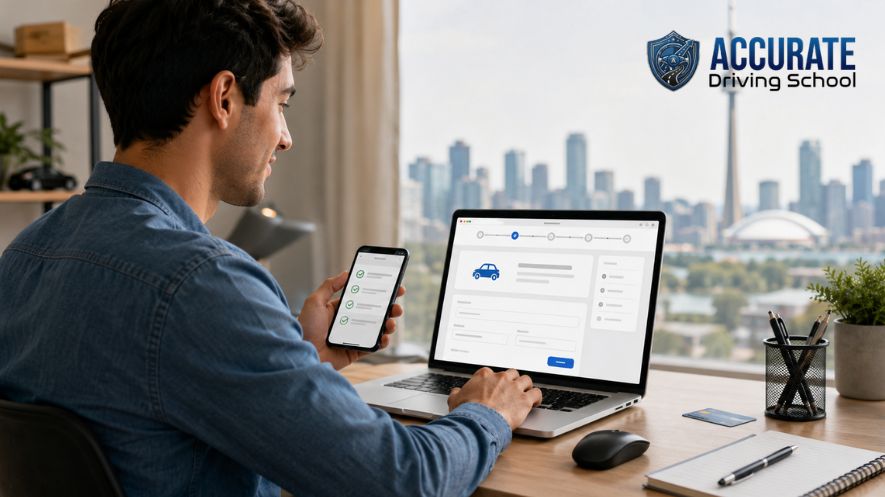
Instead of attending every theory lesson in a physical classroom, students can complete the digital portion of an approved Beginner Driver Education program online while arranging practical in-car lessons separately.
Ontario’s government-approved Beginner Driver Education programs can include digital or in-person classroom instruction, hands-on in-vehicle training, and flexible instruction time. Approved BDE programs must provide at least 40 hours of instruction and meet Ministry of Transportation standards.
That means online driver education can provide flexibility, but it does not eliminate the practical part of learning to drive.
If you are considering enrolling in an online driving course in Toronto, this step-by-step guide explains what to check before registering, how the process works, what happens after enrollment, and how to get the most value from your driver education.
What Is an Online Driving Course in Toronto?
An online driving course usually refers to the digital classroom portion of driver education.
Students can learn important driving theory through an approved digital learning platform instead of attending every classroom session in person.
Topics may include:
- Ontario traffic laws
- Road signs
- Right-of-way rules
- Defensive driving
- Hazard recognition
- Distracted driving
- Impaired driving
- Safe following distances
- Intersections
- Highway driving
- Weather conditions
- Sharing the road
- Responsible driving behaviour
However, if you are enrolling in an MTO-approved Beginner Driver Education course, the full program involves more than online theory.
Ontario’s official BDE structure includes classroom or digital instruction, practical in-car training, and flexible instruction time. The Ministry’s published standards describe a minimum 40-hour program, which may include at least 20 hours of classroom instruction, 10 hours of in-vehicle training, and 10 hours of flexible instruction.
This combination helps students understand driving rules and then apply them in real traffic.
Why Take an Online Driving Course in Toronto?
Toronto students often have busy schedules.
You may be balancing:
- School
- University
- Work
- Family responsibilities
- Sports
- Social commitments
- Commuting
Online learning can make driver education easier to fit into your routine.
Instead of travelling repeatedly to a classroom, you may be able to complete eligible digital learning components from home.
This can be particularly helpful in Toronto, where travelling across the city can take significant time.
An online course may also allow you to study in a quieter environment and spend more time reviewing subjects you find difficult.
However, convenience should not be the only reason you choose a course.
The most important question is whether the school and program are legitimate and appropriate for your licensing goals.
Step 1: Understand Your Ontario Licensing Stage
Before enrolling, determine where you currently are in Ontario’s graduated licensing system.
For most new Class G drivers, the process begins with a G1 licence.
Ontario requires applicants to meet licensing requirements such as age, identification, vision testing, and knowledge testing. DriveTest states that applicants for a Class G licence must generally be at least 16 years old and complete the required testing stages.
If you already have your G1, an approved BDE program can become particularly relevant because successful completion may reduce the amount of time you need to remain at the G1 level before becoming eligible for the G2 road test.
DriveTest states that a driver who completes an approved Beginner Driver Education course can become eligible for the G2 road test after 8 months instead of the usual 12 months.
This does not mean the course guarantees a G2 licence.
You still need to:
- Complete the program successfully
- Gain practical driving experience
- Meet licensing requirements
- Book the road test
- Pass the G2 road test
But completing an approved course can help eligible students progress through the licensing system sooner.
Step 2: Decide Whether You Need an MTO-Approved BDE Course
This is one of the most important decisions.
Not every online driving course is an official Beginner Driver Education program.
Some websites may offer:
- Practice questions
- Driving theory videos
- G1 test preparation
- Defensive driving information
- General educational material
These can be useful, but they are not necessarily equivalent to completing an MTO-approved BDE course.
DriveTest states that BDE is not mandatory for taking the G2 road test, but it can provide important benefits when completed through an MTO-approved school and instructor.
If your goals include:
- Structured beginner education
- Official course completion
- Potentially reducing your G1 waiting period
- Possible insurance-related benefits
then you should specifically look for an MTO-approved Beginner Driver Education program.
Do not assume that the words “online driving course” automatically mean government approved.
Step 3: Verify That the Driving School Is Government Approved
Before paying anything, verify the school.
Ontario maintains an official list of government-approved driving schools.
The province specifically recommends checking that the school is approved and not listed among revoked schools before enrolling.
This is one of the simplest ways to protect yourself from enrolling in a course that does not provide the official benefits you expected.
When comparing Toronto driving schools, check:
- School name
- Approval status
- Course availability
- BDE offering
- In-car training
- Contact information
If you cannot find the school on the official list, contact the school and ask for clarification before registering.
A professional school should be able to explain its approval status clearly.
Step 4: Confirm That the Course Includes Digital Instruction
If your goal is to study theory online, confirm that the particular BDE program offers digital learning.
Ontario-approved programs may include digital or in-person classroom instruction.
Do not assume every approved school offers the same delivery format.
Ask:
Is the classroom portion fully online?
Is the learning self-paced or scheduled?
Do I need to attend live virtual classes?
How long do I have to complete the online portion?
Can I access the course using a phone, tablet, or computer?
These questions help you understand exactly what you are buying.
Step 5: Review the Complete Course Structure
An online BDE course is not simply an online video course.
The full program includes multiple components.
The Ontario MTO Driver’s Handbook describes approved BDE courses as requiring at least 40 hours of training, which may consist of:
- At least 20 hours of classroom instruction
- At least 10 hours of in-vehicle instruction
- At least 10 hours of flexible instruction
Flexible instruction may involve activities such as:
- Computer-based learning
- Homework
- Additional classroom learning
- Driving simulation
- In-vehicle instruction
Before enrolling, ask the school to explain exactly how its program is divided.
You should understand:
- What you complete online
- What must be completed in the car
- What activities count toward flexible learning
- When the course is considered complete
Step 6: Compare Driving Schools Carefully
Do not register with the first school you find.
Compare several providers.
Look at:
- MTO approval
- Course structure
- Online platform
- Instructor availability
- In-car scheduling
- Service area
- Pickup arrangements
- Customer support
- Cancellation policies
- Course completion requirements
- Student feedback
Price can be part of the decision, but it should not be the only factor.
A slightly less expensive course may become frustrating if in-car lessons are difficult to schedule.
A better-value school should provide a clear and organized learning process from registration through practical training.
Step 7: Check Whether In-Car Lessons Are Convenient for Your Toronto Location
Online theory can be completed from home, but in-car training still requires real driving.
This means the school’s practical service area matters.
Toronto is large.
A school may serve:
- Scarborough
- North York
- Etobicoke
- Downtown Toronto
- East York
- York
but not necessarily every neighbourhood.
Before paying, ask:
Where do in-car lessons begin?
Do you offer pickup from home?
Can you pick me up from school or work?
Are there additional travel charges?
Does pickup time count as part of my lesson?
This can make a major difference to the overall convenience of your course.
Step 8: Review the Online Learning Requirements
Online does not always mean completely unrestricted.
Approved digital driver instruction still has to follow Ministry requirements.
Ontario regulations specifically address digital driving instruction and require approved schools and qualified instructors to meet applicable requirements for delivering digital instruction.
Your school may therefore have requirements relating to:
- Identity verification
- Course progression
- Minimum lesson time
- Knowledge checks
- Module completion
- Assessments
- Attendance or login tracking
Do not rush through the material simply to finish quickly.
The course is intended to help you understand concepts you will later use while driving in real traffic.
Step 9: Gather the Information Needed to Register
Once you have chosen a school, prepare the information needed for registration.
Requirements vary by school, but you may be asked for information such as:
- Full legal name
- Contact information
- Email address
- Date of birth
- Driver’s licence information
- G1 licence details
- Address
Make sure you enter information accurately.
Your official course completion eventually needs to be connected to your driver record.
If you make an error in your licence details or legal name, certification can become more complicated.
Step 10: Complete the Registration Form
Most online driving schools provide an online registration form.
Read it carefully.
Check:
- Course name
- BDE status
- Amount due
- Cancellation policy
- Refund policy
- Course access period
- In-car lesson requirements
Before submitting payment, make sure you are registering for the correct course.
For example, do not accidentally purchase only a G1 preparation program if your goal is to complete a full MTO-approved BDE course.
Step 11: Read the Terms Before Paying
Students often skip this step.
Don’t.
Pay attention to:
- Refund conditions
- Expiry dates
- Rescheduling fees
- Missed lesson policies
- Course completion deadlines
- In-car booking policies
Driving schools may have different rules for cancelling an in-car lesson.
If you cancel at the last minute, you may lose that lesson or be charged a fee.
Understanding the policies before enrollment can prevent unnecessary problems later.
Step 12: Create Your Online Course Account
After registration, the school will normally give you access to its learning platform.
You may receive:
- Login details
- A registration link
- Temporary password
- Course instructions
Save these securely.
Do not share your account with another person.
The course is associated with your own driver education record.
Once logged in, review the course dashboard before starting.
Find out:
- Number of modules
- Progress tracker
- Assessments
- Support contact
- Completion requirements
Step 13: Create a Study Schedule
One disadvantage of flexible online learning is that it becomes easy to procrastinate.
Set a realistic schedule.
For example:
Monday: one module
Wednesday: one module
Friday: review
Weekend: additional learning or practice
Choose a schedule that fits your life.
It is better to study consistently than to attempt to complete large amounts of material at once.
Driver education involves information that can directly affect your safety.
Give it proper attention.
Step 14: Study the Course Material Carefully
Topics covered in driver education are not simply academic.
You will need to apply them while moving through traffic.
Pay attention to subjects such as:
- Right-of-way
- Road signs
- Traffic lights
- Speed limits
- Intersections
- Blind spots
- Lane changes
- Following distance
- Emergency situations
- Pedestrian safety
- Cyclist awareness
Toronto driving makes many of these skills especially important because drivers frequently share busy roads with:
- Pedestrians
- Cyclists
- Transit vehicles
- Delivery vehicles
- Taxis
- Rideshare vehicles
- Heavy commuter traffic
Understanding the theory makes practical lessons more productive.
Step 15: Use the Official MTO Driver’s Handbook Alongside Your Course
Your driving school course should not be your only learning resource.
Ontario’s official Driver’s Handbook contains information about:
- Road rules
- Safe driving
- Traffic signs
- Licensing
- Vehicle operation
Ontario also provides sample knowledge-test questions that use the same general multiple-choice format students can expect from the knowledge test.
Using the handbook alongside your online course can reinforce important topics.
If something in your course seems unclear, check the official handbook or ask your instructor.
Step 16: Complete Required Online Assessments
Your digital program may contain:
- Quizzes
- Knowledge checks
- Module tests
- Final assessments
Take them seriously.
Their purpose is not simply to slow you down.
They help identify whether you understand the material.
When you get something wrong, find out why.
For example, if you repeatedly make mistakes involving right-of-way rules, spend more time reviewing intersections before moving on.
Your goal should be understanding, not simply achieving a passing score.
Step 17: Begin Your In-Car Driving Lessons
Online learning teaches theory.
Now you need to apply it.
In-car lessons are where concepts become physical driving skills.
You may practise:
- Steering
- Braking
- Acceleration
- Turns
- Lane changes
- Parking
- Observation
- Blind-spot checks
- Intersections
- Traffic judgment
A qualified instructor can identify habits that you may not notice yourself.
For example:
You may think you are checking your mirrors enough.
Your instructor may notice that your checks happen too late.
That kind of feedback is difficult to get from online learning alone.
Step 18: Connect Online Learning With Practical Driving
Try to link the two parts of the course.
Suppose you study lane changes online.
During your next driving lesson, tell your instructor:
“I want to practise the lane-change procedure we covered in the course.”
Then work on:
- Mirror check
- Signal
- Blind-spot check
- Speed control
- Space judgment
- Smooth movement into the new lane
This creates a stronger connection between knowledge and action.
Step 19: Practise Between Professional Lessons
Professional lessons are important, but repetition is also necessary.
Where legally permitted and with an eligible accompanying driver, practise the skills your instructor teaches you.
Focus on:
- Smooth braking
- Turns
- Parking
- Observation
- Lane position
Do not simply drive randomly.
Use feedback from your instructor to guide your practice.
A useful approach is to keep a small driving journal.
After each lesson, write:
What went well?
What needs improvement?
What should I practise before the next lesson?
This can make your training more efficient.
Step 20: Complete All BDE Components
Do not assume finishing the online modules means the entire course is complete.
You still need to meet all required components of the program.
Ontario’s approved BDE structure includes digital/classroom, in-car, and flexible instruction components.
Your school should tell you when all requirements have been satisfied.
Keep track of:
- Online modules
- Assessments
- In-car hours
- Flexible instruction
- Outstanding requirements
If you are unsure, contact the school before assuming you have completed the program.
Step 21: Confirm That Your Course Completion Has Been Certified
This step is extremely important.
Ontario states that after successfully completing a government-approved BDE course, the driving school certifies the student online and the student’s driver record is updated through the Ministry of Transportation.
DriveTest also explains that the accelerated G2 eligibility applies only once the school has entered the successful training results into the appropriate MTO systems.
So after finishing the course, ask:
“Has my BDE completion been submitted to the Ministry?”
Do not simply assume that finishing your final lesson automatically updates the system instantly.
Step 22: Get Proof of Completion if Needed
Ontario explains that students can order their driver’s licence history if they need official proof of BDE completion.
You might need proof for reasons such as:
- Insurance
- Personal records
- Verification
Ask your school what documentation you should expect and how course completion is recorded.
Step 23: Check Your G2 Road-Test Eligibility
Once your approved BDE course has been successfully completed and properly recorded, eligible drivers may be able to take the G2 road test after eight months at the G1 level rather than twelve months.
However, eligibility does not necessarily mean readiness.
Before booking, ask yourself:
- Can I drive without constant instructions?
- Are my observations consistent?
- Can I park confidently?
- Are my turns controlled?
- Do I understand right-of-way?
- Can I respond calmly to traffic?
If the answer is no, additional practice may be worthwhile.
Passing sooner is less important than becoming a safe driver.
Step 24: Book the G2 Road Test When You Are Ready
Ontario road tests can be booked through DriveTest.
DriveTest allows customers to book and pay for G2 and other road tests online.
Use official booking channels.
Be cautious with third-party websites that may charge additional service fees or create confusion.
Before booking, make sure:
- You are eligible
- Your course completion has been recorded where applicable
- You are comfortable driving independently
- You have an appropriate vehicle available
Step 25: Take a Road-Test Preparation Lesson
Even after completing BDE, a focused road-test lesson can be useful.
Your instructor can evaluate:
- Observation
- Turns
- Lane changes
- Parking
- Speed control
- Intersections
- Following distance
Ask for honest feedback.
A good question is:
“If my test were tomorrow, what are the three biggest things that could cause me problems?”
Then practise those areas.
How Long Does an Online Driving Course Take?
The official BDE requirement is based on instructional hours rather than simply the number of calendar days.
Ontario-approved programs require at least 40 hours of total instruction.
How quickly you complete the overall program depends on:
- Online course schedule
- Your study pace
- In-car instructor availability
- Your personal schedule
- Program requirements
Do not choose a course simply because it promises extremely fast completion.
Driver education should develop real understanding.
Can You Complete the Entire Driving Course Online?
No, not if you mean a full government-approved Beginner Driver Education program.
The digital classroom portion can be completed online, but approved BDE also includes hands-on in-vehicle training.
You cannot learn:
- Steering
- Parking
- Traffic judgment
- Blind-spot checks
- Vehicle control
through a screen alone.
The online portion provides knowledge.
The in-car portion develops skill.
Both matter.
Does an Online BDE Course Guarantee a G2 Pass?
No.
No legitimate driving school can guarantee that you will pass a road test.
The course can:
- Teach the rules
- Improve your driving skills
- Build confidence
- Provide professional feedback
But the final result depends on your performance during the road test.
The examiner evaluates whether you can drive safely and independently.
Can an Online Driving Course Help With Insurance?
DriveTest notes that successfully completing an approved BDE course may provide opportunities for insurance rate discounts.
However, insurance benefits are not guaranteed.
Every insurer has its own criteria.
Before enrolling mainly for insurance reasons, contact your insurance provider and ask:
“Do you recognize completion of an MTO-approved Beginner Driver Education program?”
That gives you information specific to your policy.
Common Mistakes When Enrolling in an Online Driving Course
Choosing a Course Without Checking MTO Approval
This is one of the biggest mistakes.
If you want official BDE benefits, verify approval first.
Assuming “Online” Means No In-Car Training
A proper approved BDE program includes practical driving instruction.
Choosing Only by Price
Course quality and instructor availability matter.
Ignoring the Cancellation Policy
Missed lessons may carry fees.
Rushing Through the Online Modules
The material is meant to prepare you for real driving.
Waiting Too Long to Book In-Car Lessons
Practical lesson availability may differ from online course access.
Ask about scheduling early.
Questions to Ask Before Enrolling
Before registering with an online driving school in Toronto, ask:
- Are you an MTO-approved BDE provider?
- Is the theory portion available online?
- How is the 40-hour course structured?
- How many in-car hours are included?
- How do I schedule practical lessons?
- Which Toronto areas do you serve?
- Is pickup available?
- What is the cancellation policy?
- How long do I have to complete the course?
- How is course completion submitted to the Ministry?
- Who should I contact if I have problems with the online platform?
- Are there any additional requirements I should know about?
Clear answers are a good sign of an organized school.
Who Benefits Most From Online Driver Education?
Online learning can be especially convenient for:
High-School Students
They can study around classes and homework.
University and College Students
Flexible learning works well with changing schedules.
Working Adults
Online modules can be completed outside working hours.
Parents
Learning from home can reduce travel.
Nervous Drivers
Studying rules before entering traffic can make early driving lessons feel less overwhelming.
Newcomers
Ontario-specific driver education can help experienced drivers understand local road rules and expectations.
Online Driving Course vs Traditional Classroom Learning
Neither method is automatically better.
Online May Be Better If You:
- Need flexibility
- Prefer independent study
- Want to avoid commuting to class
- Have a busy schedule
- Learn well digitally
Classroom May Be Better If You:
- Prefer direct interaction
- Need a fixed schedule
- Like asking questions in real time
- Learn better in a group
The quality of instruction matters more than the format alone.
How to Get the Most Value From Your Online Driving Course
Treat the course seriously.
Do not simply play modules in the background.
Instead:
- Take notes
- Review difficult topics
- Ask questions
- Read the MTO Driver’s Handbook
- Connect theory to practical lessons
- Practise consistently
- Listen to instructor feedback
Your goal should be to become a safe driver, not simply finish a program.
Why Toronto Drivers Need Strong Hazard Awareness
Toronto presents many situations that new drivers need to manage confidently.
These can include:
- Busy intersections
- Pedestrians
- Cyclists
- Transit vehicles
- Parked cars
- Construction
- Heavy commuter traffic
- Highway entrances
- Changing road conditions
A strong online driving course should help you understand hazard awareness before you begin dealing with these situations behind the wheel.
Your instructor can then help you practise safe responses in real traffic.
Final Thoughts: Enrolling in an Online Driving Course in Toronto
Enrolling in an online driving course in Toronto can be a convenient and effective way to begin structured driver education.
But the process should start with one important step:
Verify that the driving school and BDE program are government approved if you want official Beginner Driver Education benefits.
Ontario-approved BDE programs combine digital or classroom instruction with practical in-car training and flexible learning, with at least 40 hours of total instruction required.
From there, the enrollment process is straightforward:
Choose an approved school.
Compare its program and policies.
Register with accurate information.
Complete the online learning.
Arrange your in-car training.
Practise what you learn.
Complete all course requirements.
Confirm that your successful completion has been entered into the Ministry system.
Then prepare for the G2 road test when you are both eligible and genuinely ready.
Successfully completing an approved BDE program can allow eligible students to take the G2 road test after eight months rather than the usual twelve months, but the course does not replace real driving experience or guarantee a pass.
The best online driving course is therefore not simply the fastest or most convenient one.
It is the course that gives you a strong understanding of Ontario road rules, access to qualified practical instruction, and the confidence to make safe decisions independently.
Use online learning to build knowledge.
Use in-car lessons to develop skill.
Use practice to turn those skills into safe driving habits.
That combination will prepare you not only for your G2 road test, but for years of driving on Toronto and Ontario roads.
Frequently Asked Questions
Can I take a driving course online in Toronto?
Yes. Ontario-approved Beginner Driver Education programs may include digital classroom instruction, although the full BDE program also includes in-vehicle training and flexible instruction.
How do I know if an online driving school is MTO approved?
Check Ontario’s official list of government-approved driving schools before registering. The province recommends verifying the school’s approval status and checking that it has not been revoked.
How long is an MTO-approved BDE course?
Approved programs require a minimum of 40 hours of instruction. Ontario’s published structure may include at least 20 hours of classroom instruction, 10 hours of in-vehicle training, and 10 hours of flexible instruction.
Can I complete all 40 hours online?
No. Approved BDE includes practical in-car instruction in addition to digital or classroom learning.
Does an online driving course reduce the G1 waiting period?
Successful completion of an approved BDE course can allow eligible drivers to take the G2 road test after approximately eight months instead of twelve months.
Is Beginner Driver Education mandatory for the G2 road test?
No. DriveTest states that BDE is not mandatory for the Class G2 road test, although an approved course can offer educational and licensing benefits.
Does completing BDE guarantee I will pass the G2 test?
No. You must still demonstrate the required driving skills during the official road test.
How is my BDE completion recorded?
After successful completion of an approved program, the driving school certifies you online and your student driver record is updated through the Ministry of Transportation.
How can I prove that I completed BDE?
Ontario states that you can obtain proof by ordering your driver’s licence history.
Can BDE help with car insurance?
Completing an approved BDE program may provide opportunities for insurance discounts, but eligibility and savings depend on the insurer.
When should I book my in-car lessons?
It is generally better to discuss in-car availability when you enroll rather than waiting until the end of your online learning. This helps you plan the full course efficiently.
Can I book my G2 test online?
Yes. DriveTest provides online road-test booking for G2 and other licence classes.
Should I take a practice lesson before my G2 test?
A focused road-test preparation lesson can help identify weaknesses in observation, parking, turns, lane changes, and overall road awareness before your test.
Is online driving school better than classroom training?
It depends on your learning style. Online courses offer flexibility and convenience, while classroom instruction may suit students who prefer face-to-face learning and a fixed schedule.
What should I look for when choosing an online driving course in Toronto?
Look for government approval where applicable, clear course requirements, qualified instructors, convenient in-car scheduling, transparent policies, and a structured program that focuses on safe driving rather than simply finishing quickly.